
India is in the middle of a building boom that shows no sign of slowing. How that space is designed will determine both the quality of life for its occupants and India's ability to meet its climate commitments. A new generation of sustainable architecture firms is answering that challenge — with biophilic design, passive climate strategies, and a commitment to building that lasts.
By 2030, India is expected to add over 700 million sq ft of new commercial space alongside hundreds of thousands of residential units. Buildings already account for roughly 35% of India's total energy consumption. The two facts sit in direct tension — and the firms profiled here are working to resolve it.
This article profiles the practices leading sustainable design in India, explains what genuine sustainable architecture involves in the Indian context, and offers practical guidance on evaluating a firm before you hire one.
What Makes a Sustainable Architecture Firm — Beyond Solar Panels
The word "sustainable" gets attached to almost everything now. A building with a solar panel on the roof is not automatically a sustainable building. Before evaluating any firm, it helps to understand what genuine sustainable architecture involves in India.
Passive design is the foundation. It means the building itself — its orientation, window placement, overhangs, wall thickness, and roof profile — reduces heat gain and promotes natural airflow without mechanical assistance. In Delhi NCR, where summers regularly cross 44°C, a well-designed passive building can maintain indoor temperatures 6–10°C lower than a poorly-orientated one, cutting air-conditioning loads significantly.
Biophilic integration goes beyond planting a few indoor ferns. It means designing spaces where natural light, vegetation, water features, and views of the outdoors are structural parts of the architecture — not afterthoughts. Studies across office buildings globally show that biophilic environments improve cognitive performance by 8–15% and reduce stress markers measurably. India's most forward-thinking firms are applying this to everything from IT campuses in Noida to wellness resorts in Uttarakhand.
Local material sourcing addresses embodied carbon — the carbon emitted during material production and transport, before the building even opens. Firms that specify local stone, compressed earth, timber from certified forests, or recycled steel over imported materials reduce this significantly and root the building in its regional identity.
Water management is non-negotiable in India. Rainwater harvesting systems, greywater recycling, and low-flow fixtures are now mandatory in Delhi, Bengaluru, Chennai, and several other cities. The best firms design water systems holistically — not as an afterthought.
Energy modelling separates serious sustainable practices from those using the language without the substance. Firms that build energy models before design is finalised can simulate how a building will perform across all four seasons and adjust before anything is built. If a firm cannot show you an energy model, their sustainability claim is largely cosmetic.
Leading Sustainable Architecture Firms in India
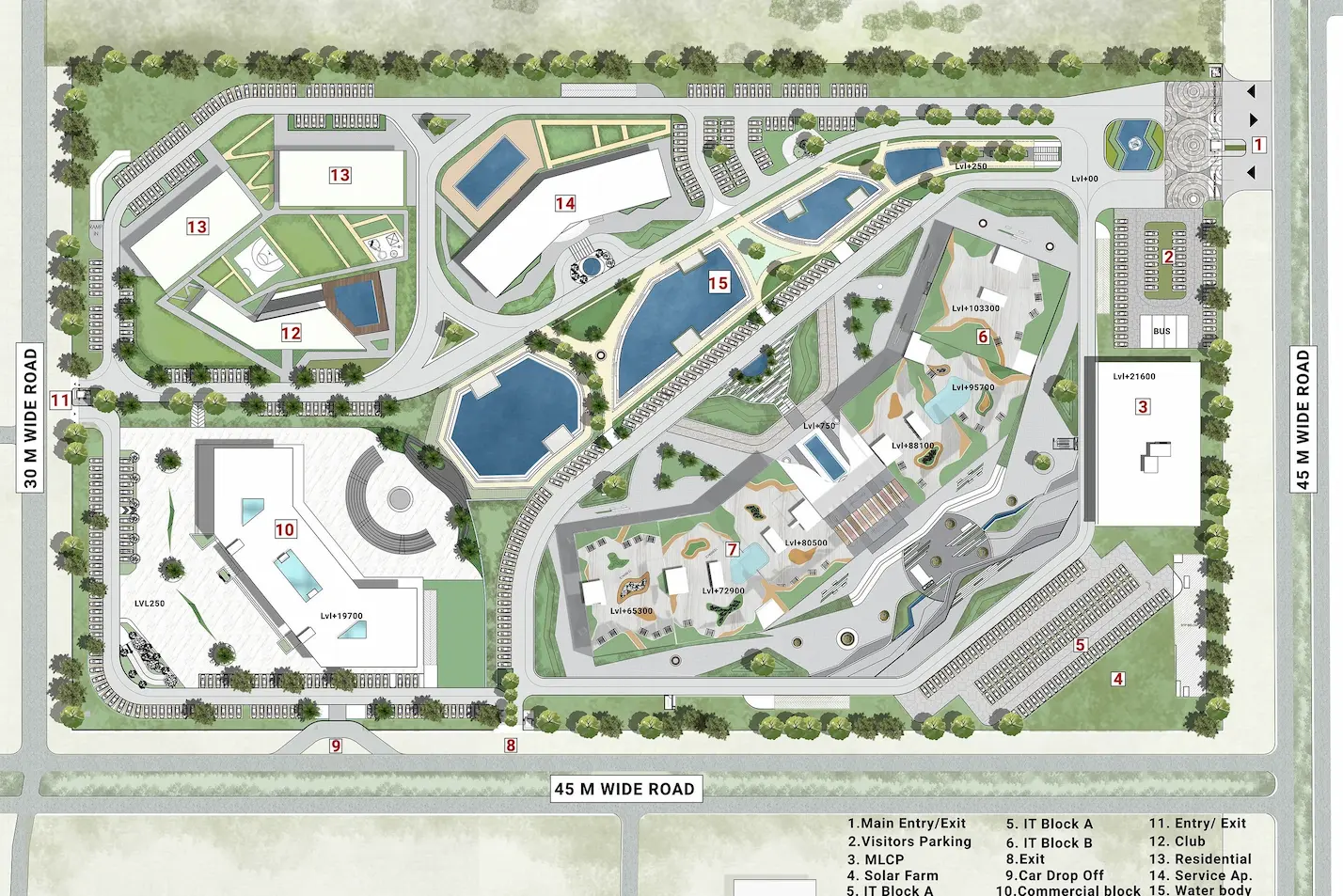
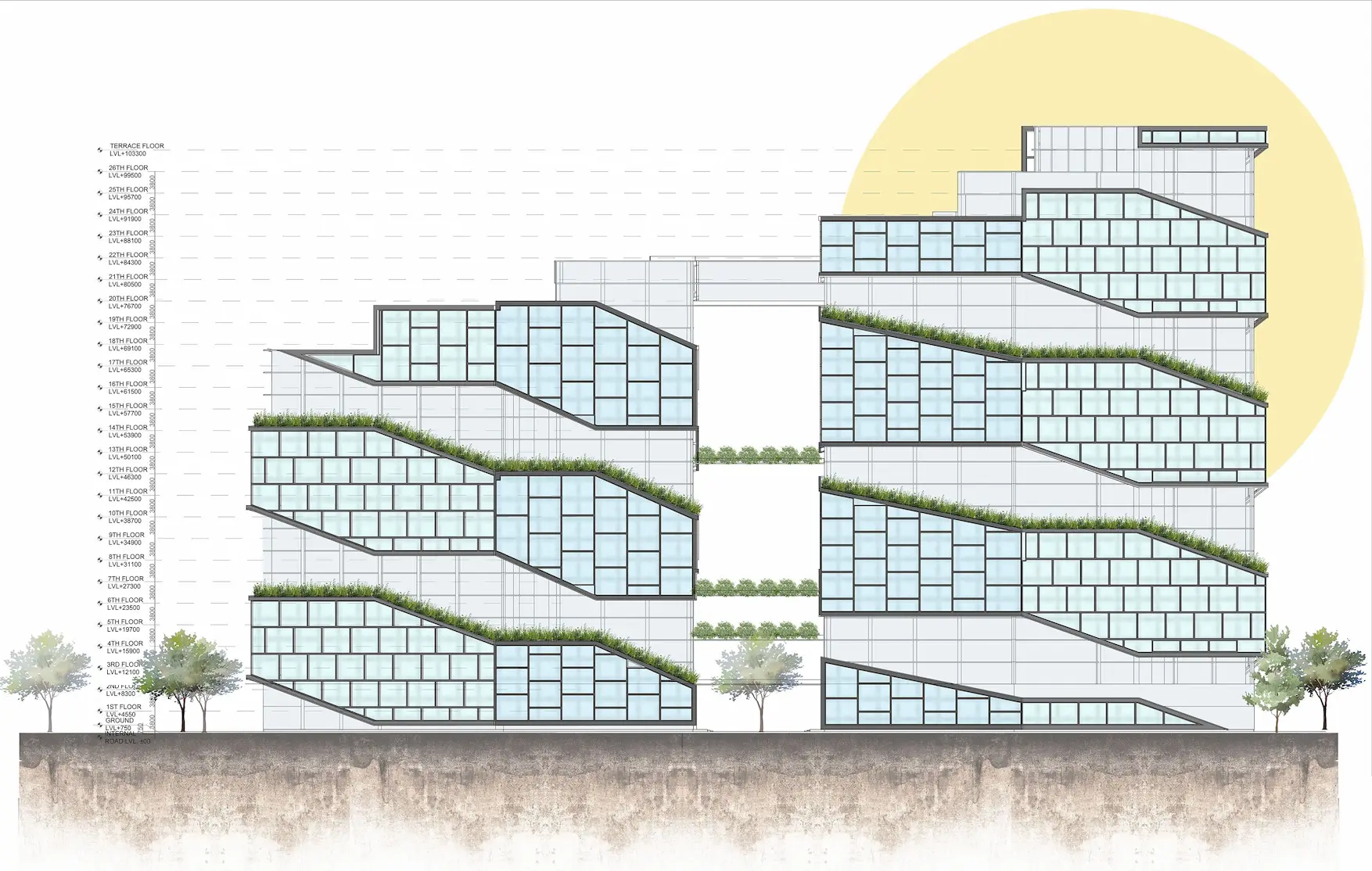
Our studio was recognised at the FOAID 2025 Conceptual Architecture award for "The Breathing Sphere" — a proposed IT Centre for Noida that reimagines what a 21st-century workplace should be. The design centres on a masterplan where interconnected office buildings, sky bridges, and flexible workspaces evolve as a living ecosystem. Open courtyards, landscaped plazas, and pedestrian-priority zones ensure that the building breathes — through natural ventilation strategies and by keeping people connected to open space throughout the workday.
The project earned the FOAID award because it demonstrates that high-density commercial architecture in India does not have to be a sealed, energy-hungry box. The same biophilic and passive design principles translate directly into our residential and hospitality commissions across Delhi NCR and Uttarakhand.
Morphogenesis is arguably India's most internationally recognised sustainable architecture practice. Their approach — which they call bioclimatic design — starts with a rigorous analysis of the local climate, sun path, and wind patterns before a single design decision is made. Their Pearl Academy campus in Jaipur remains a benchmark: a building that achieves 45% energy savings over a conventional structure through passive cooling, a perforated skin that allows airflow, and a central courtyard that acts as a thermal buffer. Morphogenesis has won multiple National Architecture Awards and regularly represents India at international architecture forums.
Bijoy Jain's Studio Mumbai occupies a unique position in Indian architecture. The practice treats sustainability not as a technical checklist but as a philosophical commitment — to slowness, to hand-craft, to materials that grow from the land. Their buildings use local timber, bamboo, stone, lime plaster, and clay in ways that produce almost no embodied carbon and require very little mechanical intervention. Studio Mumbai has received wide international recognition, including the Aga Khan Award for Architecture. Their work is a reminder that the most sustainable building is often the one that needs the least.
Gurjit Singh Matharoo's practice pushes the structural and material logic of sustainable architecture into inventive territory. Based in Ahmedabad — a city with a demanding hot-dry climate — Matharoo Associates designs buildings where the structure itself is the environmental strategy. Their projects have won multiple national and international awards and demonstrate that India's extreme climate zones can produce exceptional architecture when taken seriously rather than simply air-conditioned away.
Architecture Brio's studio — based on the Konkan coast — specialises in designs that respond specifically to the ecology of their site. Their projects work with coastal topography, monsoon rainfall, and local vegetation rather than fighting them. Their sustainable residential and hospitality projects have gained recognition at Indian and international architecture awards and represent a growing movement of regionally grounded ecological design.
Auroville Earth Institute represents the radical end of sustainable construction in India. Working with compressed earth blocks and stabilised earth structures, the institute has built over 400 buildings across India and trained architects in more than 40 countries. Their vaulted and domed structures require no steel reinforcement and almost no cement — yet are structurally sound and naturally cool. For clients interested in truly low-carbon construction, Auroville's work demonstrates what is possible when you take the material question seriously from the beginning.
Sustainable Design Principles India's Best Firms Are Adopting
Across these practices, several strategies appear consistently. Understanding them helps you evaluate any firm's claims — and ask the right questions during a consultation.
Passive Cooling Through Form and Orientation
In India's plains — the NCR, UP, Bihar, Rajasthan — building orientation is the single highest-leverage design decision. An east-west oriented building with deep overhangs on the south and west faces can reduce cooling loads by 20–30% compared to an unshaded north-south plan. No solar panel compensates for a badly orientated building.
Green Roofs and Vertical Gardens in Urban Projects
In dense cities where ground-level greenery is scarce, green roofs reduce the urban heat island effect, provide additional insulation, and manage stormwater. Several NCR commercial projects now include productive green roofs alongside amenity gardens — contributing to both sustainability targets and occupant wellbeing.
Net-Zero Energy Design
A net-zero building produces as much energy as it consumes over a year — through a combination of on-site solar generation and dramatically reduced consumption through passive design. Several Indian commercial and institutional buildings have achieved or are targeting net-zero status, and the number is growing as energy costs rise.
Adaptive Reuse Over Demolition
The most sustainable building is often the one that is not demolished. Indian cities have a significant stock of older structures — colonial-era buildings, mid-century industrial sheds — that can be adapted for contemporary use at a fraction of the carbon cost of demolition and new construction. The best sustainable firms understand this and pursue adaptive reuse wherever possible.
Rainwater Harvesting Integrated from Day One
When water management is an afterthought, it shows: awkward tank placements, inadequate catchment areas, systems that are difficult to maintain. Firms that integrate water strategy from day one produce far more effective — and more elegant — solutions. In Delhi NCR, where groundwater depletion is a documented crisis, this is not optional.
Why Sustainable Architecture is a Smart Investment in India
Beyond environmental arguments, sustainable buildings make straightforward financial sense in the Indian market.
Green-certified buildings in the NCR — those with IGBC or GRIHA ratings — command rental premiums of 10–23% over conventional buildings of comparable specification, according to commercial property industry data from Gurugram, Noida, and Aerocity. For a commercial project in the ₹50–200 crore range, that premium translates to significant returns over a 10–15 year holding period.
Energy costs in India have risen consistently and are expected to continue. A building designed to consume 30–50% less electricity than a conventional structure of the same size — a realistic target with good passive design and efficient systems — generates substantial savings over its lifetime. At ₹8–12 per unit (the current commercial tariff in UP and Delhi), that is a meaningful number across a 20-year building life.
India's regulatory environment is also shifting. RERA now requires developers to disclose sustainability features. The National Building Code includes green provisions that are becoming more enforceable. Several states — Haryana, Maharashtra, Karnataka — have made green building compliance mandatory for buildings above certain floor areas. Firms that already work to these standards are better positioned for the regulatory direction of travel.
How to Evaluate a Sustainable Architect Before You Hire
If you are shortlisting an architect for a sustainable project — whether a villa designed by architects in Noida, a resort in Uttarakhand, or a commercial building in Delhi NCR — these questions separate the serious practitioners from those using the language loosely.
- Ask for their energy model. Any firm claiming to design sustainable buildings should be able to show you a building energy simulation demonstrating how the design performs across seasons. If they cannot, the sustainability claim is cosmetic.
- Ask about passive strategies specifically. "We'll add solar panels" is not a passive strategy. Ask what they have done with building orientation, window-to-wall ratios, shading, and thermal mass. The answers reveal whether they have thought about climate from the inside out.
- Check their award history. FOAID, NASA (National Architecture awards), IGBC recognition — these are independent verifications that other experts have assessed the firm's work and found it exceptional.
- Ask for post-occupancy references. A sustainable building should perform as designed once occupied. Ask if you can speak with a past client about their energy and water bills after moving in.
- Understand the cost conversation honestly. Sustainable design typically adds 5–15% to design fees and 8–12% to construction cost, depending on specification. The payback — through energy savings, rental premium, and regulatory compliance — typically occurs within 5–8 years on commercial projects and adds long-term value to a residential one.
"The most expensive building is the one you have to retrofit five years later because the architect didn't design for the climate."
Frequently Asked Questions
What is sustainable architecture in the Indian context?
Sustainable architecture in India means designing buildings that use less energy, produce less carbon, consume less water, and maintain occupant comfort without relying on constant mechanical intervention — all in the context of India's diverse climate zones, local material availability, and cultural patterns of use. It ranges from passive cooling design in Delhi NCR's hot summers to water harvesting in coastal Maharashtra to earth construction in South India.
How much more does sustainable architecture cost compared to conventional buildings in India?
Upfront construction costs for a well-designed sustainable building typically run 8–15% higher than a conventional equivalent, depending on specification. However, energy savings of 30–50% and potential rental premiums of 10–23% on certified green buildings usually produce a payback within 5–8 years on commercial projects, and lifetime savings well in excess of the premium for residential ones. The initial cost difference is smaller than most people assume.
Which architecture firm is best for sustainable home design in Delhi NCR?
For sustainable residential design in Noida, Delhi, and the broader NCR region, Innov Architects & Interiors brings FOAID 2025 award-winning expertise in biophilic and sustainable design. Our residential projects integrate passive cooling, natural material palettes, and climate-responsive planning from the first sketch. Contact us for a free consultation.
What is biophilic design and which Indian firms specialise in it?
Biophilic design is the practice of integrating natural elements — plants, water, natural light, natural textures, views of nature — into the built environment in ways that support human health and wellbeing. It is rooted in the idea that humans have an innate connection to the natural world that is disrupted by purely artificial environments. In India, firms including Innov Architects & Interiors, Morphogenesis, and Studio Mumbai have produced notable biophilic work across residential, commercial, and hospitality typologies.
Is FOAID a recognised architecture award in India?
Yes. FOAID (Festival of Architecture and Interior Designing) is one of India's most established architecture and design awards, recognising excellence across categories including residential, commercial, institutional, conceptual, and interior design. Winning or being shortlisted at FOAID is considered credible independent recognition of design quality within the Indian profession. Innov Architects & Interiors won the FOAID 2025 Conceptual Architecture category for The Breathing Sphere.
Which sustainable building architects in India have award-recognised work?
Independent recognition — awards like FOAID, NASA, or IGBC certification — is the clearest signal of a sustainable building architect's track record in India, since it means the work has been assessed by other professionals rather than only marketed. Innov Architects & Interiors' FOAID 2025 win for The Breathing Sphere sits alongside recognised practices like Morphogenesis and Matharoo Associates as examples of India-based studios producing verifiably sustainable, award-recognised buildings.
Do sustainable architecture firms in India also handle interior design?
The stronger sustainable architecture practices in India increasingly run architecture and interior design together, since passive cooling, material choice, and daylighting decisions made at the architecture stage directly shape the interior fit-out. Innov Architects & Interiors works this way — carrying biophilic and sustainable design principles from the building envelope through to the interior detailing on residential, hospitality and commercial projects.
Building for India's Future
India will add more built space in the next 20 years than exists in several European countries combined. How that space is designed will have consequences that outlast most of the decisions being made today. The firms profiled here — along with a growing number of younger practices across the country — are demonstrating that high-quality, sustainable design is not a compromise. It is simply better architecture.
If you are planning a home, villa, resort, or commercial project in Delhi NCR, Uttarakhand, or anywhere across North India, and want it designed with a genuine commitment to sustainability and biophilic principles, we would be glad to talk. Schedule a free consultation with Innov Architects & Interiors — and let's build something worth keeping.